
Plants
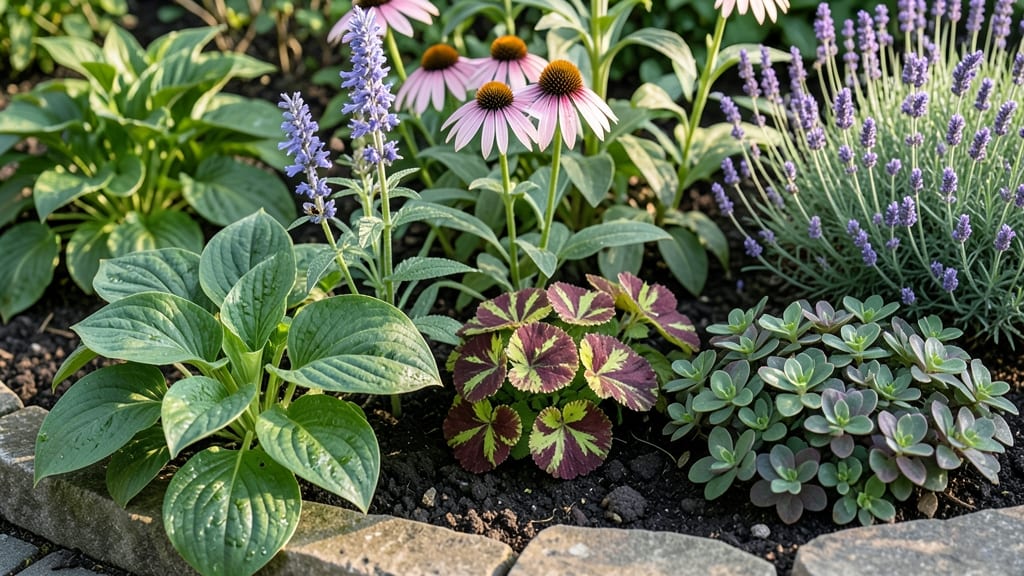
Perennial plant identification by leaf pictures saves you from guessing which plant is stealing your garden's spotlight. 🌿 I've spent years matching leaves to plants, and the key is focusing on just four features: shape, edges, veins, and arrangement. A single photo often isn’t enough—lighting and angles trick even experts—but these details narrow it down fast.
The biggest mistake? Relying on one app or book. Cross-check with at least two sources—sometimes a leaf looks like hosta but grows like a fern. I keep a small notebook to jot down textures (hairy? waxy?) and growth patterns (clumping? spreading?).
These notes become your cheat sheet when the plant blooms later.
You'll spot the subtle differences that make all the difference: the jagged lobes of astilbe vs. the smooth edges of heuchera, or how hosta leaves cup water while ferns stay flat. Once you train your eye, you'll recognize plants before they even bloom—no more mystery greenery in your beds.
This method works for shady spots, sunny borders, or even container gardens. Start with your top 10 suspect leaves, and soon you'll be naming plants like a pro. The confidence comes from practice, not perfection—every leaf teaches you something new.
The science behind leaf confusion
Identifying perennials by leaf pictures can sometimes feel like solving a puzzle with missing pieces. Why do leaves look so similar across different plants? Why do some perennials share striking resemblances despite belonging to entirely different families?
The answer lies in a mix of evolutionary adaptations, botanical quirks, and even human perception. Let’s break down the key reasons why leaf identification can be tricky—and how to turn those challenges into opportunities for sharper observation.
Plants don’t have the luxury of changing their appearance overnight, but over millions of years, they’ve developed traits that help them thrive in specific environments. Convergent evolution is a major culprit here—when unrelated plants evolve similar leaf shapes, textures, or colors to survive in the same conditions. For example:
- Sunlight adaptation: Broad, flat leaves (like those of hostas or astilbes) maximize sunlight absorption, a trait independently developed by many shade-loving perennials. This is why so many woodland plants share a similar "lobed" or "heart-shaped" leaf profile.
- Water conservation: Succulent-like leaves (e.g., sedums or sempervivums) store moisture, a feature mimicked by drought-tolerant perennials in arid climates. Even non-succulents like lamb’s ear (Stachys byzantina) develop fuzzy, silver leaves to reflect sunlight and reduce water loss.
- Predator deterrence: Toxic or unpalatable plants often develop leaves that resemble those of safe species—a strategy called Batesian mimicry. For instance, the foxglove (Digitalis purpurea) has large, veined leaves that resemble harmless wildflowers, tricking herbivores into avoiding it.
Actionable tip: 🔍 Look beyond the leaf shape. Check for subtle differences like vein patterns, leaf arrangement (alternate vs. opposite), or the presence of stipules (small leaf-like structures at the base). A magnifying glass can reveal tiny hairs, glandular dots, or unique textures that break the mold.
Some plant families are notorious for their striking uniformity. If you’ve ever stared at a patch of mint family (Lamiaceae) plants and thought, "All these leaves look the same!"—you’re not wrong. Many perennials inherit leaf structures from their ancestors, leading to family-wide similarities:
| Plant Family | Common Leaf Traits | Examples |
|---|---|---|
| Lamiaceae (Mint Family) | Square stems, opposite leaves, aromatic when crushed | Lavender, catmint (Nepeta), bee balm (Monarda) |
| Rosaceae (Rose Family) | Pinnately compound or serrated simple leaves, often with stipules | Spiraea, potentilla, some peonies |
| Asteraceae (Aster Family) | Alternate, often lobed or toothed leaves, milky sap in some | Coneflower (Echinacea), black-eyed Susan (Rudbeckia) |
| Apiaceae (Carrot Family) | Fern-like, finely divided leaves, hollow stems | Queen Anne’s lace (Daucus carota), lovage (Levisticum) |
Why it matters: While family traits narrow down options, they’re not foolproof. For example, catmint (Nepeta) and lavender (Lavandula) both belong to Lamiaceae but have distinct leaf textures—catmint is soft and fuzzy, while lavender is narrow and leathery. Actionable tip: 🌡️ Smell and touch the leaves. Aromatic compounds (like mint’s menthol) or rough surfaces (like lamb’s ear’s woolly coating) can be game-changers in identification.
Our brains are wired to categorize quickly—sometimes too quickly. When identifying leaves, these cognitive quirks can lead to mistakes:
- Shape bias: We often prioritize overall leaf shape (e.g., "heart-shaped" or "lance-shaped") over finer details. Yet, a hosta leaf (cordate, wavy edges) and a lily-of-the-valley (Convallaria majalis) leaf (also cordate but with parallel veins) can look identical at a glance.
- Color dominance: Bright green leaves grab attention, but variegated or bronze-colored leaves (like those of heuchera or Japanese painted fern) might be overlooked in a sea of green.
- Seasonal changes: Leaves morph with age, light exposure, or stress. A young salvia leaf might look entirely different from its mature counterpart, leading to misidentification.
Actionable tip: ✨ Photograph leaves from multiple angles. Capture close-ups of veins, undersides, and growth patterns. Over time, you’ll train your eye to spot the nuances your brain initially glosses over.
Leaves aren’t static—they react to their environment. Stress from drought, poor soil, or pests can alter their appearance dramatically:
- Drought stress: Leaves may curl, shrink, or develop a leathery texture. A normal hydrangea leaf is broad and papery, but one under drought might look like a boxwood leaf (small, thick, and oval).
- Nutrient deficiencies: Yellowing (chlorosis) or purple tinges can mimic diseases or different species. For example, a iron-deficient blackberry leaf might resemble a healthy raspberry leaf to an untrained eye.
- Pest damage: Chewed edges, holes, or discoloration can obscure true leaf shape. A Japanese beetle-munched rose leaf might bear little resemblance to its original form.
Actionable tip: 💡 Assess the plant’s overall health. Healthy perennials have consistent leaf patterns. If a leaf looks "off," check for signs of stress (e.g., wilting, spots) before jumping to conclusions.
Quick Fixes for Leaf ID Struggles
Identifying perennials by leaf pictures can feel like solving a puzzle—especially when leaves look eerily similar or your photos aren’t clear enough. But with the right tools and tricks, you can turn confusion into confidence.
Below, we break down common challenges and practical solutions to help you nail those plant IDs every time.
---
When your leaf pictures lack detail, even the most distinctive features disappear. This makes identification nearly impossible, leaving you guessing between hosta vs. fern or sedum vs. lamb’s ear.
How to Fix It: ✅ 🔍 Step 1: Capture High-Resolution Shots - Use natural light (morning or late afternoon) to avoid harsh shadows. - Hold your phone or camera 12–18 inches away from the leaf for a balanced close-up. - Focus on the leaf edges, veins, and texture—these are key ID markers.
✅ 🖼️ Step 2: Edit for Clarity - Use free apps like Snapseed or Adobe Lightroom Mobile to adjust brightness and sharpness. - Crop tightly around the leaf to eliminate distractions (like soil or stems). - Pro Tip: 💡 Save a before-and-after version—sometimes subtle edits reveal hidden details!
✅ 📊 Step 3: Compare with Reference Guides - Overlay your photo with a high-res database (like [iNaturalist](https://www.inaturalist.org/) or [Missouri Botanical Garden’s PlantFinder](https://www.missouribotanicalgarden.org/plantfinder)). - Look for leaf shape, margin type (smooth, serrated, lobed), and arrangement (alternate vs. opposite).
Prevention Tip: Always take multiple angles—top, side, and underside—since some perennials (like hostas) have dramatically different reverse textures!
---
Some perennials, like heuchera (coral bells) and heucherella, or sedge vs. grass, share striking resemblances. Without a second distinguishing feature (like flower or stem), you might be stuck in "leaf limbo."
How to Fix It: ✅ 🔎 Step 1: Hunt for Hidden Clues - Leaf attachment: Are leaves alternate (one per node) or opposite (paired)? - Venation pattern: Parallel veins (grasses) vs. net-like (most perennials). - Hairiness: Some leaves (like lamium) have fuzzy undersides—check with a magnifying glass!
✅ 📏 Step 2: Measure Key Features - Use a ruler or app like PlantNet to note: - Length-to-width ratio (e.g., hosta leaves are often 2–3x longer than wide). - Margin details (e.g., toothed, scalloped, or wavy). - Pro Tip: 🌡️ If possible, compare fresh vs. dried leaves—some perennials (like sedge) change texture when wilted.
✅ 🌱 Step 3: Observe the Whole Plant - If leaves are ambiguous, check: - Growth habit (spreading vs. clumping). - Flower or seed heads (even if not in bloom, dead stems can hint at identity). - Root structure (rhizomes vs. fibrous roots).
Prevention Tip: 🎯 Label plants at planting time with a waterproof tag—saves future headaches!
---
Leaves in spring vs. fall can look like different plants entirely. Variegation fades, edges brown, or new growth emerges—making ID a moving target.
How to Fix It: ✅ 📅 Step 1: Track Seasonal Shifts - Take monthly photos of the same plant to document changes. - Note when new leaves emerge (e.g., hostas unfurl bright green before maturing to blue-green).
✅ 📱 Step 2: Use Time-Lapse Apps - Apps like Gardenate or PlantSnap can cross-reference seasonal variations. - Pro Tip: ✨ If leaves are yellowing or spotted, check for disease (like powdery mildew)—this can mimic natural aging.
✅ 🌿 Step 3: Focus on Evergreen Traits - Some perennials (like heuchera or carex) retain color or texture year-round. - Compare winter vs. summer images in databases to spot consistent features.
Prevention Tip: 💡 Plant a "reference trio"—group similar-looking perennials (e.g., heuchera + heucherella + astilbe) together to compare side by side.
--- When you’re out in the garden and your phone’s dead (or you’re in a low-signal area), instant ID help vanishes.
How to Fix It: ✅ 📖 Step 1: Carry a Field Guide - Physical books like The New Sunset Western Garden Book or Wildflowers of North America are lifesavers. - Pro Tip: 🔥 Dog-ear pages for your top 10 tricky perennials!
✅ 📝 Step 2: Pre-Download Apps - Save PlantNet, PictureThis, or Google Lens offline before heading out. - Offline mode tip: 📊 Some apps (like iNaturalist) let you download leaf shape libraries for later use.
✅ 👩🌾 Step 3: Ask the Experts - Join Facebook gardening groups or local nursery forums—post photos with location tags for faster help. - Pro Tip: ✨ Take a group shot with a coin or ruler for scale—makes answers more accurate!
Prevention Tip: 🎯 Charge your phone near garden tools (or use a solar-powered charger) to avoid blackout moments.
--- - 🔍 Use a magnifying glass for leaf hairs, glandular dots, or stipules (small leaf-like structures at the base). - 📏 Compare with a leaf key (like [USDA Plants Database](https://plants.usda.gov/))—they break down traits step by step. - 📸 Take a "leaf selfie" with your hand for scale—helps judge size in photos. - 🌱 Note the soil type—some perennials (like carex sedges) prefer moist soil, while others (like lavender) thrive in dry conditions.
Frequently asked questions
What are the most important leaf features to look for when identifying perennials?
Focus on four key traits: shape (cordate, lanceolate, etc.), edges (smooth, serrated, lobed), vein pattern (parallel vs. net-like), and arrangement (alternate vs. opposite). Also check for unique textures like hairiness or waxy coatings, and whether leaves have stipules (small leaf-like structures at the base).
How can I tell the difference between similar-looking perennials like hosta and fern leaves?
Hostas have wavy edges and parallel veins that cup water, while ferns typically have delicate, lacy fronds with a feather-like structure. Look at the stem too—hostas grow from rhizomes while ferns emerge from a central crown. A magnifying glass helps spot tiny hairs or glandular dots that differ between species.
What should I do if my leaf photos aren't clear enough for identification?
Take new photos using natural light and holding your phone 12–18 inches away from the leaf. Focus on close-ups of edges, veins, and texture. Use editing apps like Snapseed to adjust brightness and crop tightly. For tricky cases, include a coin or ruler for scale—this helps compare sizes accurately in databases.
Can I identify perennials by leaves alone, or do I need flowers too?
While leaves provide 90% of the clues, flowers can confirm tricky IDs. However, many perennials (like heuchera or carex) have distinctive leaves that don't need flowers. If leaves are ambiguous, check growth habit (spreading vs. clumping) and soil preferences—some perennials thrive in moist areas while others prefer dry conditions.
What's the best free app for identifying perennials by leaf pictures?
Try PlantNet or PictureThis—both use AI to match leaf photos against databases. For offline use, download iNaturalist and save leaf shape libraries. Pro tip: Combine app results with a physical field guide like The New Sunset Western Garden Book for cross-verification.