
Planting
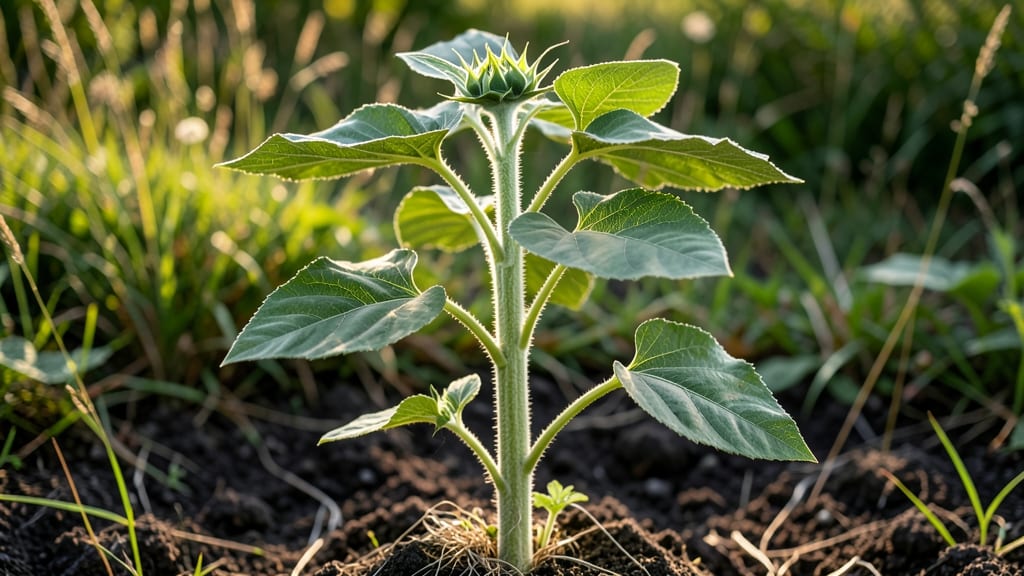
A sunflower plant leaf looks like long, lance-shaped blades with rough edges and prominent veins running parallel along the stem. These deep green leaves grow alternately in a staggered pattern, while younger foliage appears fuzzy before developing jagged edges and a waxy finish as they mature.
A sunflower's leaves are instantly recognizable by their bold structure—imagine elongated, spear-like shapes that can reach 12-24 inches in length, depending on the variety. 🌿 The parallel veins create a striking pattern that distinguishes them from other plants, while that signature fuzzy coating on baby leaves helps protect the plant during early growth stages.
What's fascinating is how the leaf texture evolves: those initial soft hairs give way to a tougher, almost leathery surface as the plant matures, perfectly adapted to withstand harsh sunlight and wind.
What makes these leaves so distinctive is their alternate arrangement along the stem—each leaf emerges at a different height, creating that iconic sunflower silhouette. This growth pattern isn't just visually striking; it's also a clever adaptation that maximizes sunlight exposure for the plant's massive blooms.
When comparing to look-alikes like Jerusalem artichoke leaves, you'll notice sunflower leaves lack the lobed or deeply serrated edges that other plants often display.
💡 In This Article
- Sunflower Leaf Anatomy: Shape, Size, and Vein Patterns
- How to Identify Sunflower Leaves vs. Common Look-Alikes
Sunflower leaf anatomy: shape, size, and vein patterns
The sunflower's leaf shape follows a precise botanical blueprint: lanceolate (spear-shaped) with a pointed tip and slightly tapered base, creating what botanists call an "elliptical-lanceolate" form.
These leaves typically measure between 12-24 inches long and 2-6 inches wide at their broadest point near the middle, though giant sunflower varieties can produce leaves up to 3 feet long.
The edges start smooth but develop shallow, irregular serrations as they mature, giving them a slightly jagged appearance when viewed closely.
The vein pattern is one of the most distinctive features—sunflower leaves exhibit parallel venation, where 5-7 prominent veins run lengthwise from base to tip, connected by delicate cross-veins forming a grid-like network.
This differs from many other plants that have pinnate venation (like maple leaves) where veins branch out from a central midrib.
The parallel veins create those striking ribbed channels that give the leaf its structural strength, allowing it to support the plant's massive weight as it grows toward the sun. 🌿 What's fascinating is how these veins contain vascular bundles that transport water and nutrients at speeds up to 1 meter per hour during peak photosynthesis.
Texture transforms dramatically as leaves age: young sunflower leaves emerge covered in fine, silvery hairs that serve as a protective barrier against pests and excessive moisture evaporation.
These hairs typically fall off by the time the plant reaches 4-6 weeks of age, revealing a rougher, almost sandpaper-like surface that develops a subtle waxy coating. This mature texture isn't just for show—it helps repel water, reducing disease risk while allowing sunlight to penetrate efficiently for photosynthesis.
The waxy layer also creates that characteristic sheen you'll notice on healthy sunflower foliage.
Leaf arrangement follows a precise mathematical pattern called alternate phyllotaxy, where each leaf emerges at a 137.5-degree angle (the golden angle) from the previous one. This spiral pattern isn't random—it's an evolutionary adaptation that maximizes sunlight exposure while minimizing shading between leaves.
When you observe a sunflower stem from above, you'll notice this mathematical precision creates a beautiful spiral that continues up to the flower head. The stem itself is typically 2-4 inches in diameter at the base, providing the structural support needed for these large leaves.
Size progression is another key feature: leaves at the base of the plant are largest (often 20+ inches long) while those near the flower head are progressively smaller, creating a natural tapering effect.
This size gradient helps the plant maintain balance as it grows taller, with the lower leaves providing most of the photosynthetic energy while the upper leaves protect the developing flower bud.
The transition from fuzzy young leaves to rough mature ones occurs in 3-5 distinct stages, each with specific survival advantages for the plant.
What's often overlooked is how leaf color changes with maturity: young leaves appear a vibrant emerald green with hints of blue-green, while mature leaves develop a deeper forest green hue with occasional yellowish-green tones near the veins.
This color shift indicates increasing chlorophyll production as the plant prepares for full sunlight exposure. The waxy coating on mature leaves also creates a subtle iridescent quality when viewed at certain angles, adding to their visual appeal. 💫