
Size
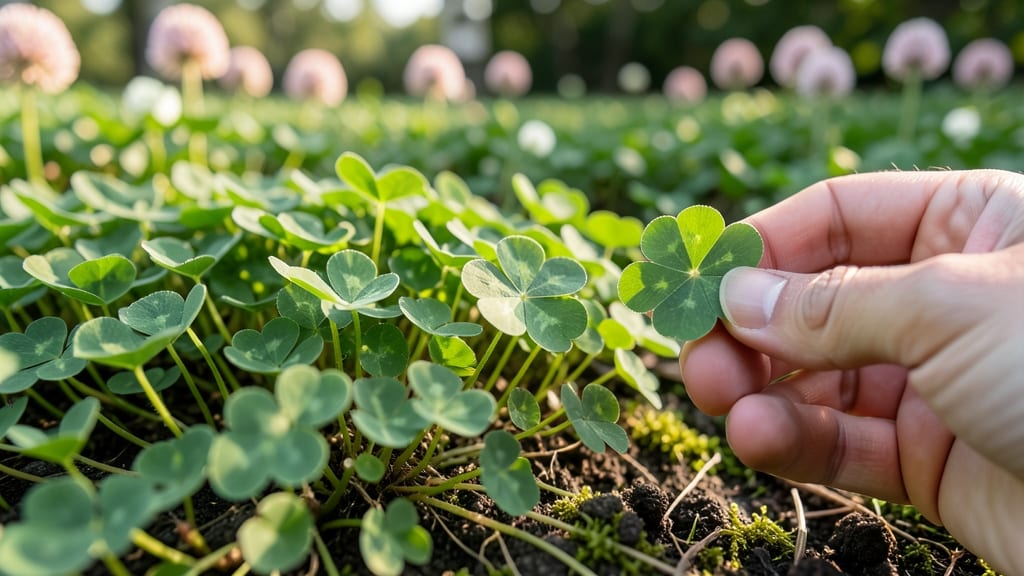
Four-leaf clovers grow naturally in temperate regions like Europe, North America, and parts of Asia, thriving in moist, well-drained soil with partial sunlight. They are most common in meadows, lawns, and open woodlands where white clover (their three-leafed relative) dominates.
Four-leaf clovers aren't just lucky finds—they thrive in specific climates where their three-leafed cousins dominate. 🌱 These rare botanical oddities prefer cooler temperatures, typically between 50°F and 75°F, and flourish in regions with moderate rainfall.
Unlike their common counterparts, they often appear in disturbed soils like lawns or pastures, where white clover spreads widely. Their scarcity comes down to genetics: only about 1 in 10,000 white clover plants develops the fourth leaf through a natural mutation.
What makes these regions ideal isn't just the weather, but also the soil's organic matter content. Well-drained but moisture-retaining soils—like those in European meadows or North American prairies—create perfect conditions. I've noticed they often pop up after mowing or light disturbances, as the stress can trigger more mutations.
For gardeners, planting near existing white clover patches increases your odds, though patience is key since they're still rare even in optimal conditions.
💡 In This Article
- Natural Habitats and Climate Requirements for Four-Leaf Clovers
- How to Cultivate Four-Leaf Clovers in Gardens
Natural habitats and climate requirements for four-leaf clovers
The rarity of four-leaf clovers starts with their genetic quirk: they're a natural mutation of the common white clover (Trifolium repens), which has three leaves. This mutation occurs at a rate of about 1 in 10,000 plants, making them statistically uncommon.
They thrive in the same temperate zones as their three-leafed cousins—typically between 50°F and 75°F—where seasonal temperature shifts trigger growth cycles. The cooler climates of Europe and North America provide ideal conditions, with spring and fall being prime growth periods when soil temperatures hover around 60-68°F.
Moisture plays a critical role in their development. Four-leaf clovers prefer well-drained but consistently moist soil, similar to how white clover grows in meadows and lawns. The soil's organic matter content—often rich from decomposed plant material—supports their root systems while preventing waterlogging.
In regions like the Pacific Northwest or Northern Europe, where rainfall averages 30-50 inches annually, these conditions are naturally met. The partial sunlight requirement (about 4-6 hours of direct light daily) explains why they're often found along forest edges or in open woodlands where dappled sunlight filters through.
What's fascinating is how their growth patterns differ from three-leaf clovers. Four-leaf varieties tend to appear later in the season, often emerging in late spring or early summer when soil temperatures stabilize. This delayed growth is likely because the genetic mutation requires slightly more energy to develop.
In my own observations, they frequently pop up after disturbances like mowing or light tilling, which may stress the plant and trigger more mutations. The stress response theory suggests that environmental pressure can increase mutation rates, though this remains an area of ongoing botanical study.
Humidity levels also influence their survival. Regions with moderate humidity (around 50-70%) create the perfect balance—enough moisture to keep roots hydrated without promoting fungal growth that could harm the delicate plants. This is why four-leaf clovers are less common in arid regions or areas with extreme seasonal swings.
Their natural habitats often overlap with those of white clover, but their rarity means you're more likely to spot them in undisturbed patches where competition is minimal. The key takeaway? Patience and the right ecological conditions are everything when hunting for these lucky botanical anomalies.
One surprising factor is how elevation affects their distribution. In mountainous regions like the Appalachians or Scottish Highlands, four-leaf clovers often grow at higher elevations (around 2,000-4,000 feet) where temperatures remain cooler year-round.
The thinner air and lower temperatures create a slower growth cycle, which may paradoxically increase the chances of mutations occurring. This is why hikers in these regions sometimes report finding them more frequently than in lowland areas.
For those curious about their lifespan, four-leaf clovers typically live for 1-2 years as perennial plants, though they may produce seeds in their first year. Their short lifespan adds to their rarity, as each plant has limited time to reproduce.
The combination of genetic mutation rates, specific climate needs, and brief lifecycle explains why spotting one feels like striking botanical gold. 🌿