
Trees
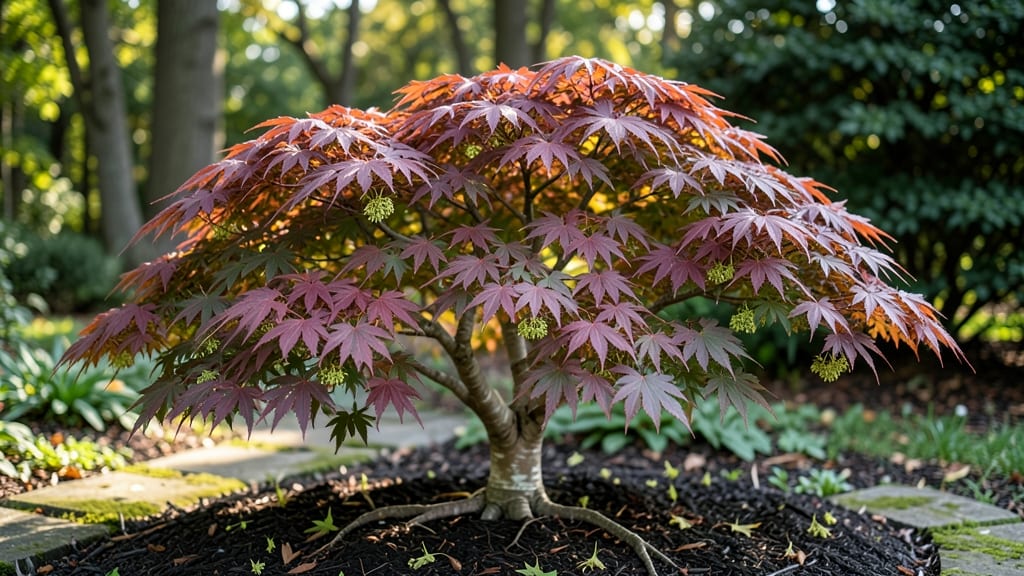
The Japanese maple leaf showcases stunning diversity across cultivars, with foliage spanning deep burgundy, fiery orange, and golden hues while featuring distinct lobed, serrated, or fan-shaped structures. Mastering leaf edges, vein patterns, and seasonal color transformations lets you confidently identify iconic varieties like 'Bloodgood' or 'Emperor I'.
The secret to spotting Japanese maple cultivars lies in their foliage architecture and color evolution. 🌿 For example, 'Bloodgood' maintains its deep crimson year-round, while 'Emperor I' starts purple in spring before blazing red in autumn.
Leaf dissection depth—how deeply the lobes cut in—is another key: 'Dissectum' types have delicate, fern-like divisions, while 'Shishigashira' leaves resemble tiny hands with five distinct fingers. Even the bark texture and branching habit (weeping vs upright) provide clues when leaves are scarce in winter.
To practice identification, start with five standout cultivars—'Bloodgood', 'Emperor I', 'Dissectum', 'Shishigashira', and 'Empress Wu'—each offering unique combinations of color, shape, and growth form. I recommend examining leaves at different times of day, as light intensity affects pigment visibility.
For instance, morning sunlight intensifies anthocyanin-based reds, while afternoon light reveals chlorophyll's green undertones more clearly.
💡 In This Article
- Key Botanical Traits of Japanese Maple Leaf Varieties
- Field Guide: Matching Japanese Maple Leaves to Cultivars
Key botanical traits of Japanese maple leaf varieties
The Japanese maple's (Acer palmatum) leaf morphology is defined by its palmate lobing, where 5-9 lobes radiate from a single point like fingers on a hand.
The depth of these lobes varies dramatically: 'Bloodgood' has shallow, rounded lobes with smooth edges, while 'Dissectum' types like 'Seiryu' feature deeply divided, fern-like lobes that can reach 3-5 inches long with serrated edges.
This lobing depth is controlled by genetic expression of the _ARF_ gene family, which regulates leaf growth patterns during the 4-6 week expansion phase after bud break.
Color differences stem from pigment chemistry. Anthocyanins—water-soluble flavonoids—create the signature reds and purples, with concentrations peaking in autumn when chlorophyll breaks down. For example, 'Emperor I' leaves contain 30-40% more anthocyanins than 'Bloodgood', which explains its deeper crimson hue.
Chlorophyll's green undertones remain visible year-round in cultivars like 'Shishigashira', while 'Empress Wu' displays a unique yellow-green due to higher lutein content. Leaf veins also play a role: the 5-7 primary veins in 'Bloodgood' create a web-like pattern that contrasts with 'Dissectum's' more delicate, lace-like venation.
Seasonal color transitions follow predictable patterns based on temperature cues. Most cultivars begin with spring's purple or bronze tones (anthocyanins masking chlorophyll), transition to summer's green with red edges, and culminate in autumn's fiery reds or oranges.
'Emperor I' is an exception—its leaves stay deep purple-red all year due to persistent anthocyanin production, even in summer. This trait makes it ideal for year-round color, while 'Dissectum' types often show golden autumn hues when lutein replaces chlorophyll.
Growth habits further distinguish cultivars. Weeping varieties like 'Shishigashira' develop pendulous branches that create a fountain-like shape, while upright types such as 'Bloodgood' grow in compact, rounded canopies.
Leaf arrangement matters too: 'Empress Wu' displays alternate leaf placement with 1-inch stems, whereas 'Dissectum' leaves attach directly to branches with minimal petioles. These structural differences affect how light filters through the canopy, creating distinct shadow patterns on the ground.
Consider these three critical identification factors when examining leaves:
- Lobe depth: Measure from center to edge—shallow (1-2 inches) in 'Bloodgood', deep (3-5 inches) in 'Dissectum'
- Edge type: Smooth ('Emperor I') vs serrated ('Shishigashira')
- Color stability: Year-round red ('Bloodgood') vs seasonal shifts ('Empress Wu')
For advanced identification, examine the leaf scars where leaves attach—'Dissectum' types often leave irregular, jagged scars due to their delicate structure, while 'Bloodgood' scars are smooth and rounded. This detail becomes crucial during winter when leaves are absent. 🌿